Top 10 Benefits of Turnkey Automation Systems for Your Business

In today’s fast-paced business environment, "turnkey automation systems" have emerged as a transformative solution. These systems streamline operations and boost efficiency. Experts in the field, like Sarah Thompson, highlight the significance of automation: "Companies must evolve or risk falling behind." Her words resonate as businesses increasingly seek innovative ways to enhance productivity.

Turnkey automation systems offer a straightforward approach for organizations to implement automation without extensive customization. These systems can integrate seamlessly with existing workflows, making the transition smoother. However, not all businesses leverage their full potential. Some companies struggle to understand how to best utilize these automated solutions.

Choosing the right turnkey automation system requires careful consideration. Companies must reflect on their specific needs and the possible pitfalls of automation. Automation should not merely replace human effort but enhance it. A balanced approach leads to sustainable growth and long-term benefits. Ultimately, adopting turnkey automation systems can be a game changer, provided that businesses approach it with strategic foresight and open-mindedness.

Top 10 Benefits of Turnkey Automation Systems for Your Business

Understanding Turnkey Automation Systems and Their Functionality

Turnkey automation systems simplify complex processes in businesses. They provide ready-to-use solutions, streamlining operations without extensive setup. These systems include hardware and software that work together seamlessly. For example, a manufacturing plant can use such a system to automate production lines. This reduces human error and improves efficiency, which can lead to cost savings.

Understanding their functionality means recognizing the inner workings of these systems. They connect various components, like sensors and machines, through integrated software. This setup allows for real-time monitoring and data analysis. However, businesses must consider the initial investment. The cost can be significant, and not every business may see immediate returns. It’s essential to evaluate specific needs and goals before diving in. The potential benefits are clear, yet the implementation process can reveal overlooked challenges.

Top 10 Benefits of Turnkey Automation Systems for Your Business

Benefit Description Impact on Business
Increased Efficiency Streamlines operations, reducing manual tasks and errors. Enhances productivity and allows focus on core activities.
Cost Savings Reduces labor costs and minimizes waste through optimized processes. Increases overall profit margins.
Scalability Easily adaptable to growing business needs without major overhauls. Supports business expansion and flexibility.
Improved Quality Ensures consistent output and reduces defects through automation. Enhances customer satisfaction and brand loyalty.
Faster Time-to-Market Expedites production cycles, leading to quicker product launches. Improves competitiveness and market responsiveness.
Data Insights Provides analytics for better decision-making and forecasting. Enhances strategic planning and operational performance.
Enhanced Safety Reduces human error and potential hazards by utilizing machines. Improves workplace safety and compliance.
24/7 Operations Allows for continuous production without breaks, maximizing output. Increases revenue potential and service availability.
Customization Offers tailored solutions specific to business needs and processes. Enhances operational alignment and customer satisfaction.
Simplified Maintenance Simplifies troubleshooting and upkeep, often with integrated services. Reduces downtime and extends equipment lifespan.

Increased Efficiency Through Streamlined Processes and Workflows

Turnkey automation systems can significantly enhance efficiency in your business. These systems simplify complex workflows and make processes smoother. Imagine a factory where machines run automatically, reducing manual labor. Workers can focus on critical tasks, leading to faster production and fewer errors.


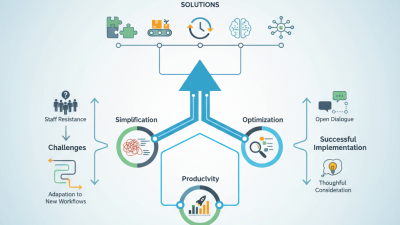
However, not all businesses adapt seamlessly to automation. Some employees may struggle with new technology. Training is essential, but it can be time-consuming and costly. Integrating automation into existing workflows requires careful planning.


Streamlined processes provide measurable benefits. For instance, response times to customer inquiries can improve dramatically. Efficiency leads to increased productivity without the need for additional staff. Yet, companies must remain vigilant. Regular assessments of automated systems are necessary to ensure they align with business goals. A reflective approach can prevent over-reliance on technology.

Cost Savings and Return on Investment with Automation Solutions

Automation solutions can lead to significant cost savings for businesses. According to a report by McKinsey, companies can reduce operational costs by up to 30% through automation. This allows resources to be reallocated effectively. Labor-intensive tasks can be handled by machines, freeing up employees for higher-value tasks. The implementation of a turnkey automation system can offer rapid deployment and immediate benefits.

Furthermore, businesses see a considerable return on investment (ROI) when implementing automation. A study from Deloitte revealed that organizations report a 20-40% increase in productivity. This boost in efficiency directly correlates with higher profits. However, there are challenges to consider. The initial investment can be substantial. Transitioning to automated systems may lead to temporary disruptions. Companies must prepare for these changes to maximize benefits.

Feedback from industry experts indicates that while the potential gains are enormous, careful planning is essential. Not all tasks may be suitable for automation. Continuous evaluation of processes is crucial. This reflection helps to identify areas where automation can truly add value.

Top 10 Benefits of Turnkey Automation Systems for Your Business

Enhanced Scalability to Support Business Growth and Adaptation

In today’s fast-paced business environment, scalability is vital. Turnkey automation systems offer enhanced scalability that can adapt to growth. A recent report by McKinsey states that companies with automation strategies experience a 20-30% increase in productivity. This flexibility allows organizations to scale operations without significant adjustments.

Moreover, automation systems reduce the time required for process modifications. According to a survey by Deloitte, 53% of organizations noted that automation improved their ability to adapt to changes rapidly. Imagine a system that updates workflows with minimal human input. However, many businesses still struggle with the initial implementation phase. It's common to face unexpected challenges, such as employee resistance or integration issues.

As companies grow, the need for efficient systems becomes more pressing. Turnkey automation systems can accommodate fluctuations in demand while minimizing operational costs. Gartner reported that businesses adopting these solutions save an average of 15% on operational expenses. Still, 40% of organizations hesitate due to fears of complexity. A balance between innovation and practicality is essential for sustainable growth.

Improved Accuracy and Reduced Human Error in Operations

Top 10 Benefits of Turnkey Automation Systems for Your Business

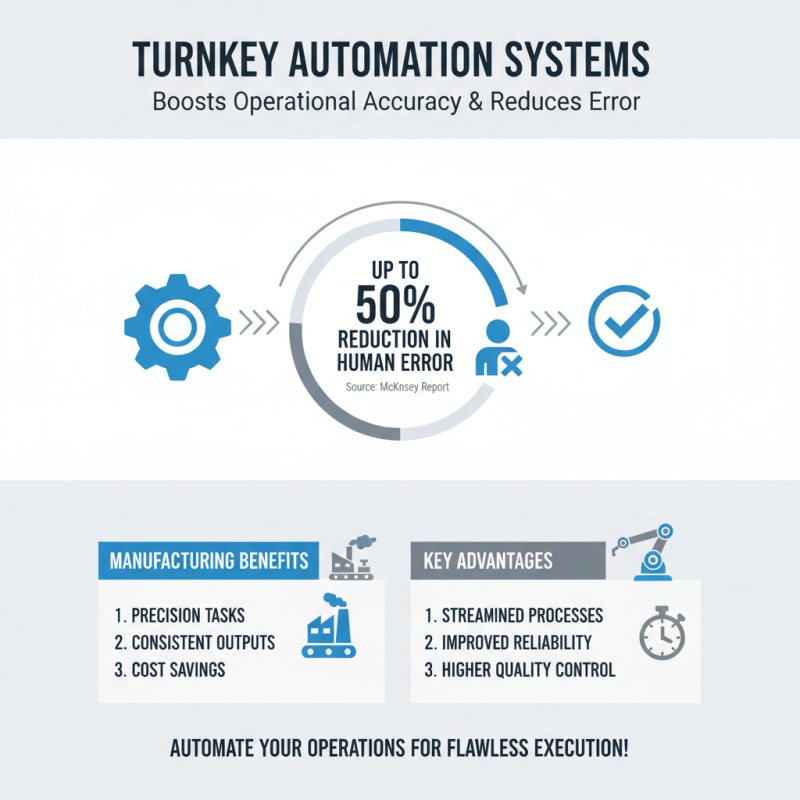
Turnkey automation systems bring a significant advantage by improving accuracy in operations. According to a report by McKinsey, companies can reduce human error by up to 50% through effective automation. This is crucial in industries like manufacturing, where even a small mistake can lead to costly errors. Automation can streamline processes, ensuring tasks are completed with precision and consistency.

Consider a warehouse setting. An automated inventory management system can track items in real-time. This minimizes the chances of miscounts, which often happen with manual entries. A study from the American Society for Quality found that 80% of defects are due to human error. This highlights the necessity of relying on automated systems for critical operations. Mistakes in shipping or stock levels can ripple through the supply chain, leading to larger issues.

While turnkey solutions promise enhanced accuracy, they also come with challenges. Some businesses struggle to fully integrate these systems into existing workflows. Employees may feel threatened by automation, fearing job loss. Transitioning requires training and patience. It's essential to address these concerns to maximize the benefits of automation.