Top 10 Robotic Solutions Manufacturers in China?
China’s robotics industry serves factories, warehouses, laboratories, and other demanding environments. Its manufacturers build robotic solutions ranging from industrial arms and mobile platforms to integrated automation lines. Yet a familiar product photo rarely tells the full story. Buyers also need to understand payload limits, cycle times, safety features, software compatibility, and local service coverage.
This guide introduces ten manufacturers to consider, not a universal ranking. Company capabilities and product ranges can change, and a strong fit depends on the task. A compact pick-and-place cell may need speed and precise repeatability; a warehouse fleet may depend more on navigation, battery life, and dependable support. Details matter.
The comparisons focus on practical questions: What applications does each company serve? Which systems can be customized? What documentation, commissioning, and after-sales assistance are available? Readers should confirm current specifications directly with manufacturers and assess equipment against their own site conditions. Certifications and performance claims also deserve careful checking. Not every brochure tells the whole story.
There is no perfect shortlist. A company with impressive hardware may offer limited integration support in a particular region, while a less familiar supplier may suit a specialized production line. Use these profiles as a starting point, then request demonstrations, references, and written technical details. Small checks can prevent costly surprises.
What Robotic Solutions Manufacturers in China Do
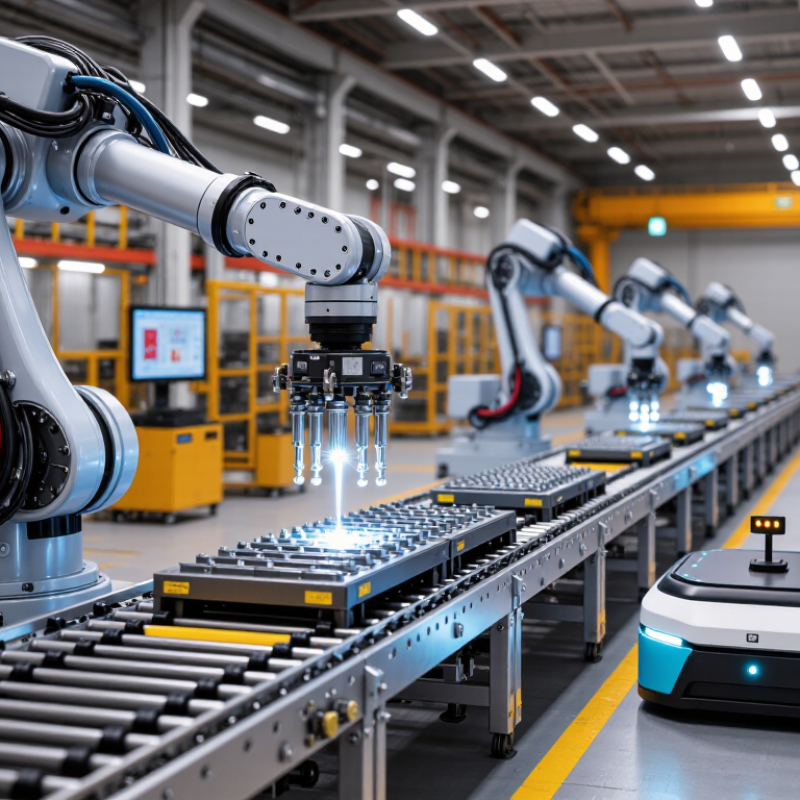
Robotic solutions manufacturers in China do more than produce robot arms. They assess factory workflows, identify repetitive or risky tasks, and propose automated work cells. A typical project may combine a robot, gripper, camera, conveyor, and control cabinet. Each part must suit the product, available floor space, and production pace.
For example, a vision system can locate metal parts on a moving belt before a robot picks and places them. The integrator programs the sequence, adjusts gripping force, and tests how the cell responds to misaligned items. Safety equipment, operator access, and connections to existing machines also need careful planning. Small details matter. A poorly placed sensor can cause delays throughout a shift.
Manufacturers may handle equipment selection, mechanical design, installation, commissioning, and staff training. They can also provide maintenance guidance and help diagnose faults after production begins. Buyers should ask how performance will be tested, what documentation is supplied, and who supports the system on site. A technically elegant cell can still miss the mark if workers find it difficult to operate. That gap is easy to underestimate, and sometimes the initial workflow assumptions need revisiting once real production starts.
How to Assess Robotics Manufacturers and Their Capabilities
A robotics manufacturer should be assessed against your actual task, not a polished product sheet. Share the part dimensions, required cycle time, shift pattern, and workspace constraints. Ask how payload affects speed at full arm extension. Request a demonstration using similar materials and realistic lighting. Details matter.
Check how the team handles integration, commissioning, and support. Ask for references from applications with comparable processes, plus clear definitions of uptime and cycle time. Review sample test records, maintenance schedules, operator training plans, and recovery steps after a fault. A capable engineering team should explain its assumptions plainly, including where extra sensors or custom tooling may be needed.
Run a pilot before committing to a full production line. Track output, rejected parts, changeover time, and recovery after interruptions across several shifts. Watch technicians as well as the robot. Their responses can reveal whether support is practical or only promised. A clean showroom demo is useful, but it may hide awkward handoffs or missing production data. No supplier is flawless; ask how problems are documented, assigned, and resolved, then check those claims during the trial.
Ten Notable Robotic Solutions Manufacturers in China
Ten Notable Robotic Solutions Manufacturers in China
China’s robotics market includes manufacturers focused on distinct factory needs. Ten notable profiles include makers of welding arms, palletizing systems, machine-tending cells, SCARA robots, collaborative arms, mobile robots, vision-guided sorters, cleanroom equipment, inspection systems, and training platforms. These are different specialties, not a verified ranking of individual companies.
Their value shows up on the factory floor. A palletizing cell must handle changing carton sizes without blocking forklift routes. A vision-guided sorter needs stable lighting and reliable image recognition. Welding systems are judged by seam consistency, cycle time, and how easily operators can reset them. Small details matter.
Buyers should compare payload, reach, accuracy, software support, and integration work—not just headline speed. Ask for a live demonstration using parts similar to your own, and clarify who handles maintenance after installation. One concern: published specifications rarely reveal every production limitation. A fast robot may still cause delays if its gripper, safety layout, or upstream equipment is poorly matched. Some systems look polished in a showroom. Real shifts are less tidy.
Industries and Applications Served by Chinese Robotics Firms
Chinese robotics firms serve a broad mix of industries, from automotive plants to small electronics workshops. In vehicle production, robotic arms weld frames, apply coatings, and move heavy components between stations. Electronics manufacturers use compact systems for precise assembly, inspection, and packaging. A misplaced connector can stop a line, so camera calibration and repeatable handling matter. That matters.
Warehouses use autonomous mobile robots to carry bins across marked routes and deliver stock to packing areas. Food processors may use robotic pickers to sort produce or place packaged goods into cartons. Some systems also support agriculture, including greenhouse monitoring and repetitive crop-handling tasks. These applications depend on the environment: wet floors, uneven lighting, or changing product shapes can challenge equipment that looked reliable during a demonstration.
Service and healthcare settings bring different demands. Robots may transport supplies in hospitals or assist with routine cleaning in commercial buildings, where safe navigation around people is essential. Yet adoption is not automatic. Not every line. A useful assessment checks cycle time, maintenance access, operator training, and how the robot behaves when a sensor is blocked. Small details count. Pilot trials can reveal awkward handoffs and downtime that a sales presentation may not show.
China Industrial Robot Installations (2019–2023)
Annual installations of industrial robots in China, in units.
Installations rose substantially between 2019 and 2022 before easing in 2023. Chinese robotics solutions serve applications across sectors such as automotive, electronics, metalworking, and plastics; this chart shows total installations, not a breakdown by industry. Source: International Federation of Robotics (IFR), World Robotics 2024.
Key Trends Shaping China’s Robotics Solutions Market
Key Trends Shaping China’s Robotics Solutions Market
China’s robotics market is shifting from rapid equipment adoption toward broader, more localized solutions. The International Federation of Robotics’ World Robotics 2024 report recorded
276,288 industrial robot installations
in China in 2023, about
51% of global installations.
The country’s operational stock exceeded
1.8 million units.
These figures point to a large installed base, but they do not show how effectively every system performs after deployment. That distinction matters.
Localization is another clear trend. IFR reported that domestic suppliers held
47% of China’s industrial robot market in 2023,
up from
28% in 2017.
Buyers increasingly need systems that combine robots with vision, grippers, software, and production-line integration.
In practical terms, a factory may need a robot to tend a machine, inspect a part, and pass reliable data to operators. AI-enabled perception and more flexible automation are attracting interest, especially where product mixes change often.
Still, integration can be difficult. Equipment that works in a demonstration cell may struggle with real-world variation, maintenance, or staff training. The market’s next test is dependable performance, not just installation volume.